
A solid oak skirting sample can confirm whether a profile and its surface suit your requirement. It cannot, on its own, establish the appearance of every board in an order or the straightness of full supplied lengths.
A useful assessment therefore covers both the piece in front of you and the limits of what it represents. Review the timber, section and preparation against the intended application, then record what has been accepted and what still needs evidence. This gives purchasing a clearer decision than an unqualified ‘sample approved’.
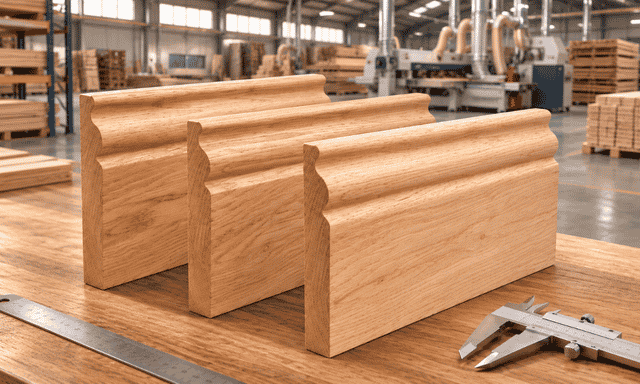
Establish what the sample represents
Identify the product reference and the drawing revision, where one exists. Confirm the timber species and whether the piece represents the proposed supply condition. A specially finished display sample may be helpful for presentation, but it does not demonstrate the surface you will receive if your order is for unfinished boards.
Ask whether the sample was selected to show the profile, an appearance level or an example of production. Those purposes are not interchangeable. If the piece is intended only to establish the moulded shape, keep the timber appearance decision open until you have suitable evidence.
A clear label helps prevent confusion later. Keep the reference and assessment date with the sample, especially when several similar sections are circulating between product, purchasing and finishing teams.
Read the timber across several pieces
Look at colour variation, grain pattern, knots and any sapwood visible on the intended face. Decide how those features relate to the range you are supplying. A board sold alongside a relatively uniform floor collection may need a different appearance brief from one intended to accompany a more characterful oak product.
One attractive offcut cannot define the acceptable range of natural variation. Ask for additional representative pieces or agreed examples showing the boundaries that matter. Describe acceptance in observable terms, including how knots or repairs will be treated where relevant, rather than relying solely on words such as ‘premium’.
Separate natural appearance from damage or machining defects. A change in grain is a timber characteristic; torn fibres around a difficult grain area are a surface condition to assess. Keeping those judgements separate makes feedback more precise.
Check the section against the application
Measure the overall height and thickness and compare the moulded detail with the agreed section. Profile names help identify a style, but they do not define every curve, rebate or proportion. Use the drawing and the physical piece together where the fit matters.
Consider the junction with adjoining components. An acceptable section in isolation may project awkwardly beyond a door architrave or provide insufficient cover for the intended wall-to-floor detail. For a flooring application, assess that cover against the floor system’s own requirements rather than assuming one skirting thickness suits every installation.
You can use L&J TOPWOOD’s published profiles to identify the section under discussion. Confirm the dimensions and any additional machining for the particular reference before approval.
Inspect the surface in useful light
Examine the visible face and moulded edges under light that makes surface irregularities apparent. Look for cutter marks, torn grain, dents and sanding scratches. Pay attention to transitions within the profile, where a flat face meets a curved or recessed detail.
Judge those observations against the agreed supply condition. A board intended for further preparation should be assessed on that basis, while a surface expected to enter a coating process needs to suit that operation. Avoid approving a preparation level that your production team has not evaluated.
If you will stain, oil or lacquer the board, carry out a trial using the intended preparation and coating system, following the coating supplier’s guidance. Keep an untreated part of the sample for comparison. A finish can change the appearance of the oak and make marks more noticeable, so the untreated inspection and finished trial answer different questions.
Recognise what needs a longer piece or a separate check
A short sample offers limited evidence about bow, twist or consistency along a full board. Where those characteristics affect handling or fitting, request representative full lengths and agree how they will be assessed. Do not infer full-length performance from a short, straight offcut.
Moisture condition also needs more than a visual judgement. Timber exchanges moisture with its surroundings and can change dimensions as conditions change. If moisture measurements form part of acceptance, agree the required condition and measurement method. Use equipment appropriate to the timber and follow its instructions, including any relevant species or temperature correction.
Record how the sample was stored before testing. A piece kept in a heated office may no longer represent the condition of material in a warehouse. This context helps explain differences without assuming either measurement is wrong.
Make the approval specific enough to use
The outcome should state which features are accepted, which require further assessment and which are outside the sample’s scope. Profile approval can be complete while a finishing trial remains open. Commercial supply conditions need their own confirmation.
Retain the assessed sample with its reference and record any agreed changes. If a revised piece arrives, distinguish it clearly from the earlier version. That leaves the next person reviewing the order with a usable decision, rather than a collection of conflicting samples.
Download the checklist to bring the sample assessment, supporting evidence and outstanding supply questions into one shared review.